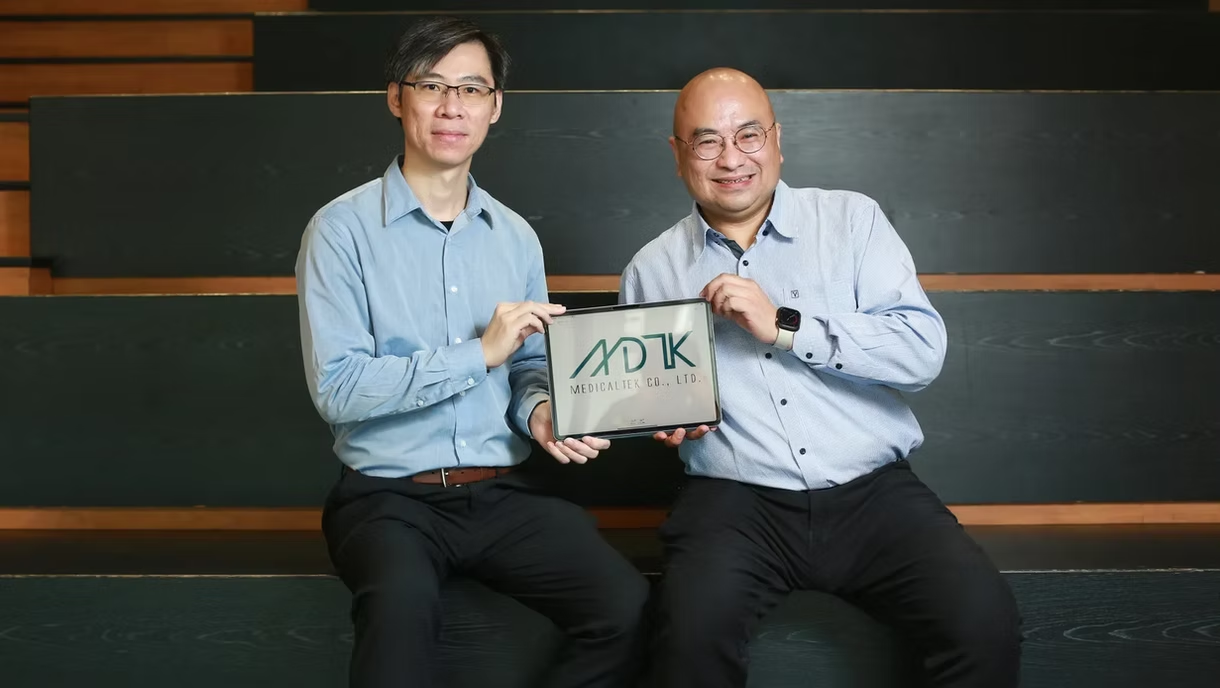

Professor Ying-Chih Chang, Co-founder and CEO of AcroCyte Therapeutics
AcroCyte Therapeutics, Inc. announced the completion of a new financing round led by BE Health Ventures, with participation from other investors including TaYa Venture Capital and Da-Ying Management Consulting. The total amount raised in this round reached US$10 million.
The new capital will primarily be used to support the clinical translation of AcroCyte’s core technology platform, process scale-up, regulatory validation, and U.S. market expansion. The company will also continue to expand its U.S.-based team, accelerating its transition from Taiwan to the global precision medicine and regenerative medicine markets.
AcroCyte is a deep-tech company focused on three-dimensional cell culture, organoids, biomanufacturing, and precision medicine. The company’s proprietary R³CE® — Rapid, Reproducible, Rare Cell 3D Expansion — technology is designed to establish a standardized, scalable, and highly reproducible platform for cell and organoid culture, addressing the limitations of traditional two-dimensional cell culture, animal models, and limited human samples, which often fail to accurately reflect real disease environments.
R³CE® Establishes a Scalable Platform for 3D Cell and Organoid Culture
R³CE® enables the cultivation of rare cells with research and clinical value from small human specimens and expands them within weeks into human cell models with three-dimensional structures. Its culture process does not rely on traditional scaffolds or animal-derived components, and its workflow is similar to conventional cell culture, while offering stability, reproducibility, and scalability. This helps lower the technical barriers to 3D cell culture and organoid research.
Its applications include circulating tumor cells(CTCs), patient-derived organoids, personalized drug testing, disease modeling, drug screening, and immune function evaluation. The cell models generated by R³CE® can also serve as research materials that more closely resemble human physiology, helping pharmaceutical companies, medical institutions, and contract research organizations improve the efficiency of drug development and preclinical research.
By providing high-quality biological data required for disease modeling, drug response prediction, and candidate drug screening through scalable and standardized human cell models, R³CE® has the potential to become a foundational platform connecting cell culture, precision medicine, AI-enabled drug discovery, and regenerative medicine.
Professor Ying-Chih Chang, Co-founder and CEO of AcroCyte Therapeutics, stated that the company’s development direction is not limited to a single disease area or product. Instead, AcroCyte aims to build a 3D cell and organoid platform capable of supporting diverse disease research and clinical applications, allowing researchers to obtain stable and human-relevant research materials more efficiently and shortening the path from breakthrough technologies in the laboratory to clinical application.
AcroCyte Wins Second Place Globally at MEDICA 2025, Earning International Recognition for Its Technology

In 2025, AcroCyte represented Taiwan at the MEDICA Start-up Competition in Düsseldorf, Germany, and stood out among more than 230 startup teams from over 45 countries, winning second place globally.
AcroCyte was not only the only Taiwanese team selected among the global top 15 finalists in that year’s competition, but also the first Taiwanese team to receive an award at the MEDICA Start-up Competition. MEDICA officially described R³CE® as a platform capable of establishing 3D cell culture and patient-specific tumor models, with further applications in personalized medicine and drug testing.
This recognition demonstrates that AcroCyte possesses not only laboratory-level technological innovation, but also increasing potential for productization, commercialization, and international market development. The company has advanced its R³CE® 3D cell culture plates into mass production and commercial sales, and established a U.S. presence in 2024 to continue building its local team and industry partnership network.
Supported by ARPA-H to Advance Clinical Translation of Kidney Organoids
Beyond precision medicine and drug development, AcroCyte is also extending R³CE® into the fields of kidney regeneration and organoid therapy.
In 2026, AcroCyte received support from the Advanced Research Projects Agency for Health(ARPA-H)in the United States to advance the RACE — Rapid and Reliable Autologous Cell Screening and Expansion for Organoid Therapy and Bioartificial Kidney Construction — program.
The program will leverage the R³CE® platform to screen and expand functional kidney progenitor cells and develop organoid-based therapeutic strategies for chronic kidney disease. Key milestones include obtaining usable kidney tissue samples, establishing a scalable manufacturing process for kidney organoids, and completing characterization and functional evaluation of organoid therapy using animal models.
For AcroCyte, ARPA-H’s support not only represents recognition of its core technology by a U.S. national healthcare innovation agency, but will also help the team establish manufacturing and validation processes aligned with future clinical and regulatory requirements. These include cell bank establishment, standardized cell expansion, organoid mass production, quality management, cross-species validation, and early engagement with the U.S. regulatory system.
With the launch of the ARPA-H program, AcroCyte will continue to deepen its U.S. presence, expand its local R&D, clinical, regulatory, and business development teams, and seek collaborations with U.S. medical institutions, research centers, and industry partners to accelerate R³CE® from a research platform toward global clinical and commercial applications.
BE Health Ventures Leads the Round to Accelerate Clinical Translation and Global Development
In addition to its technological and international achievements, AcroCyte continues to gain support from the capital market. The company recently completed a new financing round, led by BE Health Ventures, with a total amount raised of US$10 million.
Arthur Chen, Managing Partner of BE Ventures, stated:
“The R³CE® platform developed by AcroCyte demonstrates a forward-looking technological breakthrough and represents one of Taiwan’s rare deep-tech teams with global competitiveness. Its achievement as the first Taiwanese company to receive support from the U.S. ARPA-H program further highlights its technological innovation and growth potential. Through leading this round, BE Health looks forward to accelerating the team’s U.S. market expansion and global development.”
The proceeds from this financing round will be directed toward four major areas: strengthening the R³CE® core platform and related product development, advancing preclinical and clinical translation of the kidney organoid program, expanding manufacturing and quality management capabilities that meet regulatory requirements, and building a U.S. team and local market network.
Over the next 18 to 24 months, the company will continue to advance key milestones including process validation, preclinical studies, and regulatory interactions, laying the foundation for future clinical development.
From Precision Medicine to Tissue Regeneration
Looking ahead, AcroCyte will continue to expand applications of R³CE® across 3D cell culture, circulating tumor cells, patient-derived organoids, drug screening, and regenerative medicine, while gradually extending its organoid platform to kidney, liver, pancreas, and other tissue repair applications.
AcroCyte aims to build not just a single therapeutic technology, but a biomanufacturing platform that connects basic research, drug development, AI, biological data, personalized medicine, and tissue regeneration. By establishing stable, validated, and scalable cell and organoid production capabilities, the company seeks to advance regenerative medicine from the laboratory toward large-scale clinical and industrial applications, becoming a key infrastructure provider for the next generation of precision medicine and regenerative medicine.