
“We got scolded by doctors during our first demo!”
AcuSense Bio raises NT$120 million Series A by transforming 2D into 3D for minimally invasive surgery.
Yet beneath this technological leap lies a fundamental challenge: how can surgeons operate precisely on complex internal structures when they can’t see the full picture?
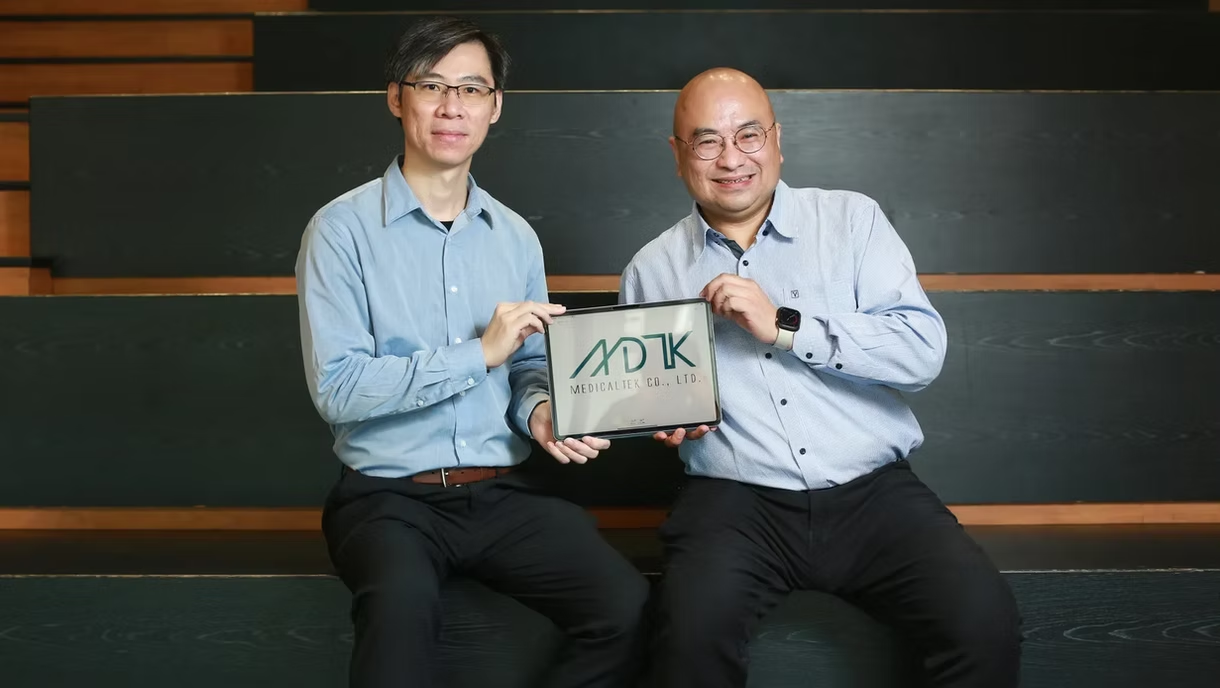
said AcuSense Bio Vice President Ian Wang (汪彥佑), pinpointing the core pain point.In traditional open surgery, surgeons can directly perceive spatial relationships between organs. In contrast, MIS relies on a single endoscopic camera, forcing surgeons to operate through a 2D view, challenged by limited depth perception and spatial awareness.
Its flagship product, the DARWIN 3D System, achieves a leap from 2D to 3D visualization, resolving long-standing visual bottlenecks and making MIS procedures more intuitive and safer for surgeons.
DARWIN 3D: Turning 2D into 3D Vision
Meanwhile, single-lens endoscopes lack sufficient multi-angle coverage, limiting the surgeon’s understanding of the surgical field and reducing precision.
The DARWIN 3D System overcomes these limitations by combining optical principles with machine learning. Through computational imaging, it generates real-time 3D visuals using only one lens, with dynamically adjustable depth-of-field suitable for confined spaces — a major technical breakthrough.
This approach enhances stability and resolves the alignment issues of traditional methods. Surgeons simply wear 3D glasses to view clear, depth-rich stereoscopic images on the monitor.
-
Real-Time 3D Conversion – Instantly transforms 2D footage into stereoscopic 3D, allowing surgeons to accurately perceive tissue depth and pathology positioning for enhanced spatial judgment.
-
Multi-Endoscope Compatibility – Supports both rigid endoscopes (for cavity surgeries) and flexible endoscopes (for gastrointestinal procedures), ensuring real-time, high-resolution image output.
-
Adaptive Parallax Adjustment – Surgeons can calibrate depth sensitivity based on personal visual comfort, providing a natural viewing experience.
Real-Time 3D Conversion – Instantly transforms 2D footage into stereoscopic 3D, allowing surgeons to accurately perceive tissue depth and pathology positioning for enhanced spatial judgment.
Multi-Endoscope Compatibility – Supports both rigid endoscopes (for cavity surgeries) and flexible endoscopes (for gastrointestinal procedures), ensuring real-time, high-resolution image output.
Adaptive Parallax Adjustment – Surgeons can calibrate depth sensitivity based on personal visual comfort, providing a natural viewing experience.
Made in Taiwan” as a Strategic Moat
“Even if competitors try to copy our technology, they won’t succeed,”
Wang stated confidently, responding to Marketing VP How-Cheng Liu’s concern about imitation.
The DARWIN System’s architecture involves complex data processing and depth computation, requiring integration with Taiwan’s GPU capabilities and advanced hardware ecosystem — a synergy that cannot be easily replicated.
“MIT (Made in Taiwan) is our competitive moat,” Wang added.