Hosted by BE Health

“My first demo got me yelled at by a doctor!” Cheng-Jun Biomedical raises NT$120 million in Series A funding for its minimally invasive 3D surgery technology.
Minimally invasive surgery represents a significant leap forward in modern medicine, with its smaller incisions and faster recovery making it highly popular. However, a deeper look reveals a formidable technical hurdle: how can surgeons precisely operate on complex organ structures without a full view?
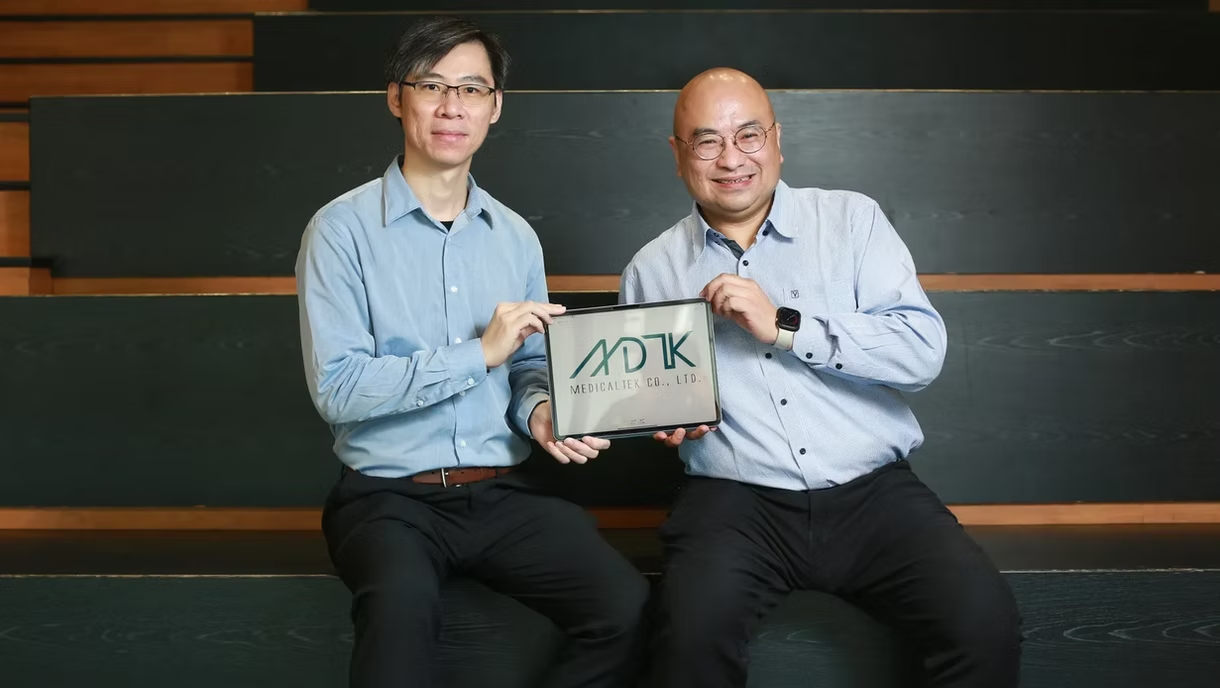
“Minimally invasive surgery involves a very small incision, but you can’t see the condition of all the organs inside,” explains Wang Yan-you, Vice President of Cheng-Yun Biomedical, succinctly highlighting the core challenge of minimally invasive surgery. In traditional open surgery, surgeons can easily grasp spatial relationships, but in minimally invasive surgery, they must operate through a single-lens endoscope, facing challenges of insufficient depth of field and a lack of spatial awareness.
Cheng-Yun Biomedical saw an opportunity for innovation in this very challenge, achieving a breakthrough from 2D to 3D with its core product, the “DARWIN 3D System.” This advancement not only overcomes the visual bottleneck but also has the potential to make minimally invasive surgery more intuitive and safer.
DARWIN 3D: Visual Transformation from 2D to 3D
Modern minimally invasive surgery relies solely on a single camera and screen, using 2D imaging, which severely tests the surgeon’s spatial awareness and medical skills.
The medical community has attempted to introduce 3D endoscopy technology, but traditional 3D endoscopes use two lenses to create stereoscopic images. When the lenses are too close, the images are prone to inaccuracy and can even cause dizziness. In addition, the images cannot be stably synthesized into 3D images when they rotate, while single-lens endoscopes are not perfect in terms of multi-angle field of view, making it difficult for doctors to fully grasp the structure of the surgical area, further affecting the efficiency and accuracy of the operation.
Cheng Yun Biomedical’s DARWIN 3D system breaks through traditional design, combining optical principles with machine learning. Through computation and image processing technology, it can generate 3D images with a single lens and flexibly adjust the depth of field to adapt to the needs of small spaces—this is its biggest technological breakthrough. It not only improves image stability but also overcomes the limitations of traditional methods. Doctors only need to wear 3D glasses to obtain clear, stereoscopic images on a monitor.
The DARWIN 3D system has three key technical highlights:
-
Real-time 3D image conversion:Converting original 2D images into 3D images allows doctors to accurately determine the depth and location of lesions and optimize visual spatial control.
-
Multi-endoscopy compatibility:It can be used with both rigid endoscopes suitable for laparoscopic surgery and flexible endoscopes suitable for intestinal surgery, ensuring immediate, high-resolution image output.
-
Parallax adjustment function:Users can adjust the settings according to their individual 3D comfort level to ensure a comfortable experience.
The viewing distance for doctors varies depending on the surgical scenario. For example, the operating distance for flexible endoscopes such as gastroscopes and colonoscopes is about 1 meter, while the viewing distance for rigid endoscopes in ENT or other surgeries is about 1.5 meters. The DARWIN system calculates the appropriate depth based on the usage scenario and reprocesses the images into a 3D effect suitable for both eyes, ensuring that viewers can clearly and comfortably observe the images at different distances, thus improving surgical efficiency and accuracy.
Wang Yanyou pointed out that this technology not only improves the accuracy of surgical procedures but also reduces surgical risks. “Doctors can more clearly grasp the depth and angle, significantly reducing damage to healthy tissues.” The DARWIN system has been successfully applied to laparoscopic and gastrointestinal examinations and serves as an important tool for doctor training, helping to detect early signs of cancer and improving treatment efficiency. In addition, Cheng Yun Biomedical’s 4K/3D medical video recorder, Lascaux, further enhances the archiving and analysis functions of medical image data, bringing a significant breakthrough to medical technology.
It is worth noting that Made in Taiwan (MIT) has become the team’s moat. “Let me tell you, even if they (competitors) want to learn our technology, they will definitely not succeed.” While Marketing Vice President Liu Haocheng was worried about the technology being imitated, Wang Yanyou was very confident, pointing out that this technology involves a complex design of data processing and deep computing, which requires the combination of Taiwan’s GPU technology and computer hardware, and is not easy to imitate.