Hosted by BE Health

Be Accelerator Is Landing in Japan to Closely Link Taiwan–Japan Biotech Startups**
Be Accelerator is entering the Japanese market to connect Japanese and Taiwanese biotech startups with real market needs. Leveraging a hospital-backed VC + accelerator operating model, we help startups complete early clinical validation, navigate national regulatory approvals, and dramatically increase success rates—building a full APAC footprint and expanding international opportunities.
Penetrating hospitals and establishing collaborations is far harder for biomedical startups than for most other industries.
Because healthcare is directly tied to human life, the industry is governed by strict, complex regulations and a culture of caution and multi-layered verification. Many assume that the hardest part is obtaining regulatory clearance—e.g., U.S. FDA authorization. Insiders know an even earlier hurdle: confirming whether the startup’s thesis addresses an Unmet Clinical Need. Without early, credible validation in clinical settings and buy-in from physicians and provider organizations, funding alone won’t move the needle. Another nuance: clinical practice is highly contextual; approaches differ from doctor to doctor—what troubles Dr. A may be routine for Dr. B.
No matter the country, the first steps to ground a biomedical startup are like walking on thin ice.
Even after step one, founders still face concept verification, product testing, and regulatory review. Early-stage teams rarely have sufficient time and resources to clear all these gates. This is one reason the U.S. long dominated biomedical innovation. In APAC, despite abundant talent, fragmented markets, language barriers, and cross-border regulatory divergences create additional frictions.
Hospital-Backed Venture Capital Amplifies Startup Success
Biomed accelerators exist for exactly this reason.
Following U.S. best practice, Mayo Clinic created its own venture arm back in 1986, aiming to shorten the long journey from frontline problem discovery → solution ideation → validation → commercialization.
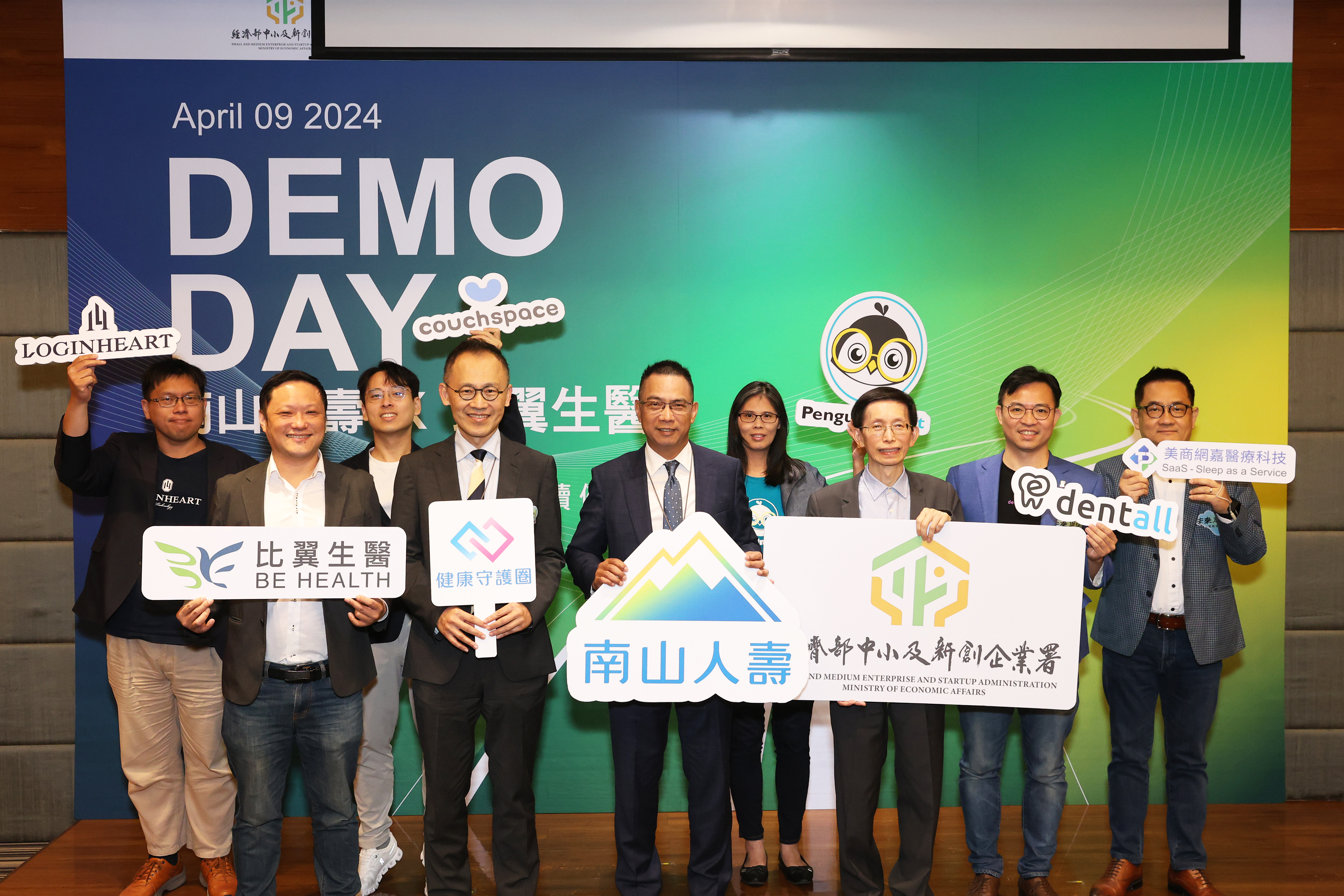
Rooted in Taiwan, Be Accelerator (比翼生醫加速器) has, over the past 6–7 years, partnered with Taipei Medical University (TMU), Show Chwan Healthcare System, and Kaohsiung Medical University (KMU), and established its own venture fund. By integrating VC × Accelerator × Hospital, Be has mentored 140+ startups worldwide and invested in nearly 30 teams, shortening typical time-to-market from 7–8 years to ~3–5 years.
“If physicians don’t use it, med-devices don’t sell.”
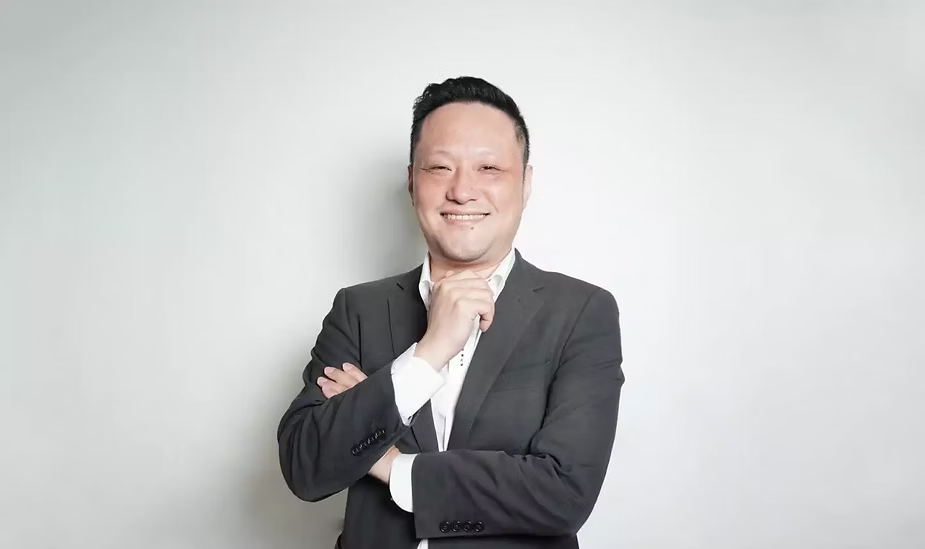
— Ian Chen, Managing Partner, Be Accelerator Ventures
In a domain that’s hard for the public to access, early clinical validation is the fastest path to confirming demand. Through collaborations with TMU, Show Chwan, and KMU, Be connects startups with clinical KOLs to validate—first-hand—whether a device truly fits physicians’ needs.
For example, Pin-Shuo Biomed, focused on precision minimally invasive devices, engaged IRCAD Taiwan (Show Chwan Asia Institute) via Be’s program and discussed concepts with world-renowned surgeon Prof. Jacques Marescaux, paving the way for subsequent clinical studies at IRCAD Taiwan.
Why Taiwan Is Ideal for Early Medtech Validation (Especially Devices)
-
High talent density across domains: Tech, healthcare, and engineering talent are abundant and cross-disciplinary matching is easy.
-
Complete supply chain: “From Keelung to Wugu, you can meet every supplier you need in a day.”
-
Robust medical databases: Taiwan’s single-payer NHI enables unified claims formats and consolidated datasets—solving the “data access” bottleneck.
-
Entrepreneurial DNA: Strong founder spirit combines hardware + software + clinical strengths on one small island.
Taiwan–Japan Collaboration to Expand Global Opportunities
Taiwan’s population is limited; after initial validation, going global is mandatory. Be positions itself as a “Gateway to Asia,” putting teams on the international stage.
The first target market is Japan—125M population, #4 global economy, and APAC’s “final boss.” Conquer Japan, and you’re better prepared for the U.S. and EU.
Japan is the #3 global healthcare market. Taiwan and Japan share historically compatible medical systems; e.g., National Taiwan University Hospital traces roots to the Japanese era. Education pipelines and professional networks have fostered long-standing exchanges.
However, traditional medical networks don’t automatically translate to the startup era. Japan’s conservative culture and etiquette slow adoption; hospital organizations are highly hierarchical—you don’t escalate straight to the top. Consensus climbs layer by layer, stretching timelines—often frustrating for resource- and time-sensitive startups.
Be Accelerator designs localization and onboarding curricula so founders can align with Japan’s “way of doing things” and integrate quickly.
“Our original intent in building the accelerator was to identify strong overseas teams, bring great healthtech to Japan, and unlock its massive domestic market.”
Toward the Gold Standard
In healthcare, the ultimate milestone is achieving the Gold Standard—protocolized, textbook-grade acceptance for when and how to treat a given problem. Earning professional recognition and sufficient evidence is the toughest and most crucial test. Be provides hands-on support for need validation, study design, and regulatory pathways.
Best-in-Class APAC Launchpad
Be isn’t the only Taiwan–Japan biomed accelerator, but it holds a strategic advantage.
“Typical accelerators don’t have direct hospital ties—they work outside-in.
Our hospital-venture network works inside-out, giving our portfolio a head start.”
— Ian Chen
Through embedded partnerships with Taiwan’s major providers, Be connects directly to Tohoku University Hospital (Japan’s #3 by many metrics) and collaborates with University of Tokyo networks. From day one in Japan, startups engage the clinical core.
With a six-year track record, Be’s thesis is a multi-country, multi-center APAC blueprint.
As Taiwan aligns with Japan, Be is pushing for multinational clinical studies so outcomes generalize across borders—reducing redundant validation in each country. The vision: a connected Asia—Taiwan, Japan, Singapore, China, and beyond—where policy and market are interoperable.
Japan is step one. Be is coordinating:
-
early July business exchanges in Kansai with Startup Island TAIWAN,
-
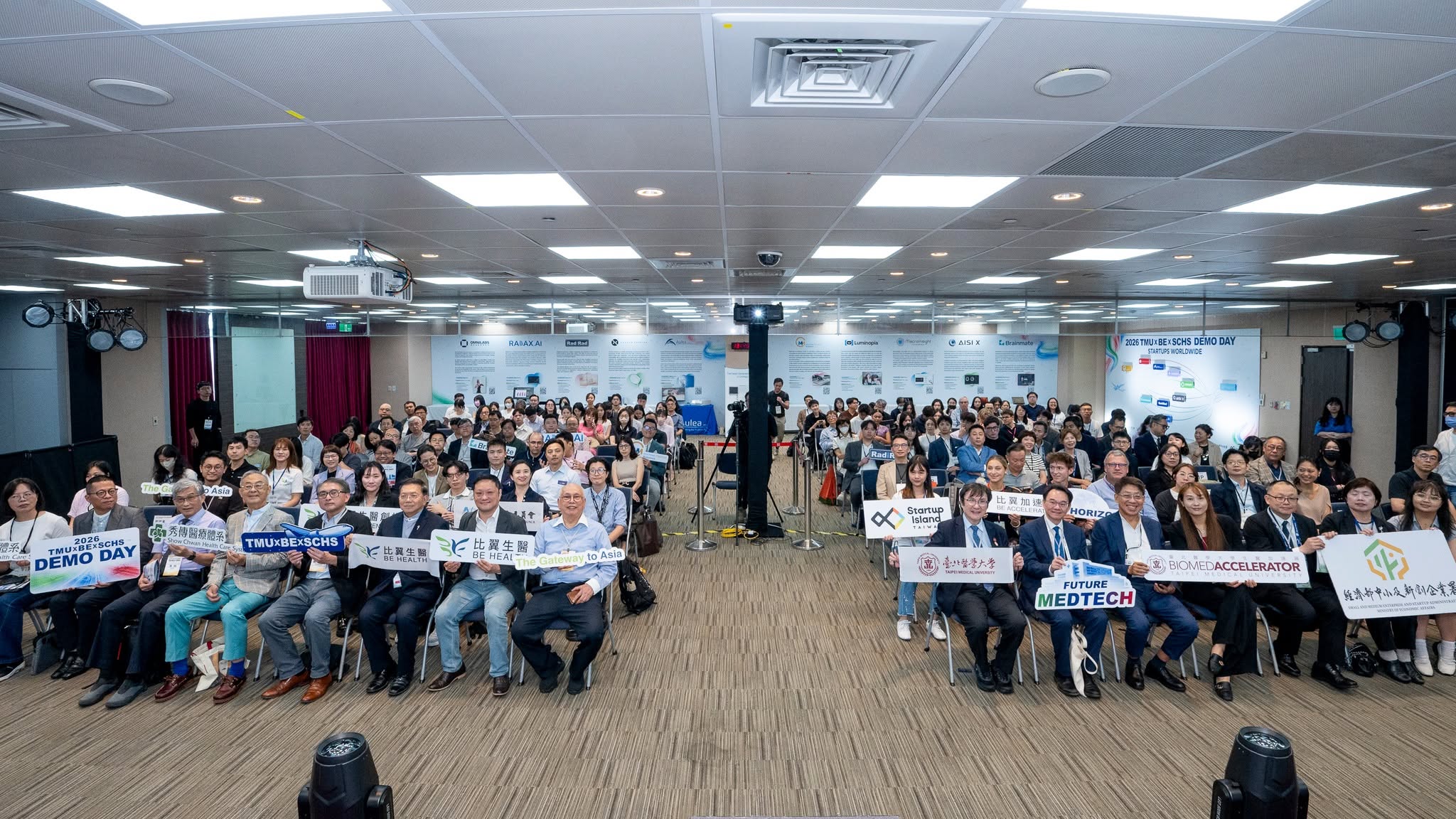
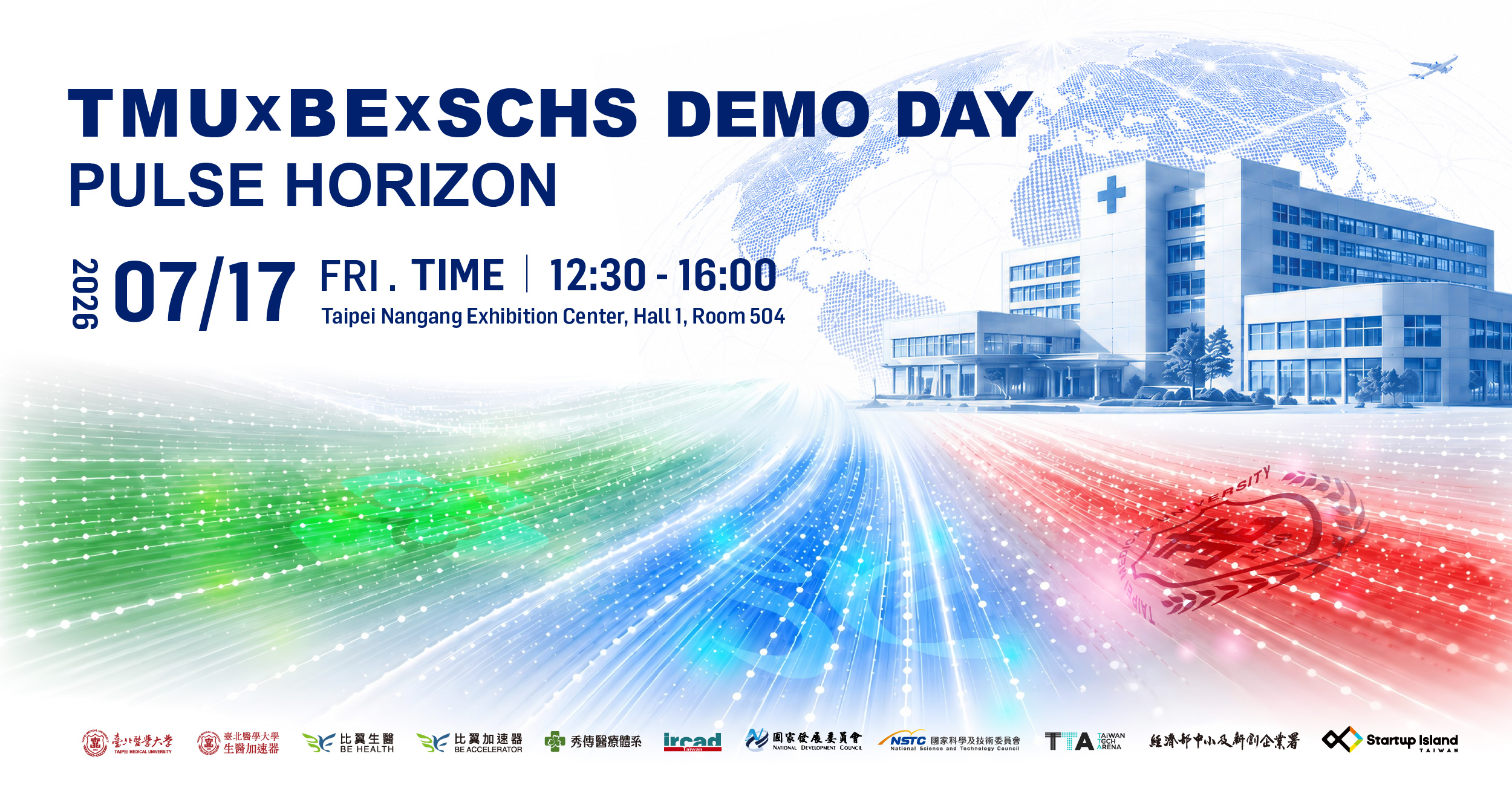
late July Demo Day in Taiwan,
-
October participation in Medical Japan Tokyo, and more.
Next up: local incorporation in Japan to run an on-the-ground accelerator. With Japan’s mature market, clear regulation and reimbursement, and a growing pipeline of strong teams and products, Be’s cross-border network helps startups plug directly into APAC’s core healthcare markets.
Japan is near—from Taiwan, about the length of a movie to reach Tokyo. Japan is also far—without a guide, doors stay closed. True to the name “Be (Flying in Pairs)”, Be acts as the bridge between venture and startup—taking flight together in healthcare.